Peer Review Process
JAFOTIK implements a triple-blind peer-review process to ensure the objectivity, fairness, confidentiality, and academic quality of manuscripts submitted for publication. Under this system, the identities of the authors, reviewers, and handling editors are concealed from one another during the peer-review process. The journal takes appropriate measures to protect the confidentiality of manuscript files, review reports, and editorial communications.
Each manuscript that passes the initial editorial screening is evaluated by three independent reviewers with expertise relevant to the subject of the submission. The reviewers assess the manuscript's originality, scientific contribution, relevance to the journal's focus and scope, methodological rigor, validity of the results, quality of the discussion, and clarity of presentation. The final publication decision is made by the Editor-in-Chief or an authorized editorial decision-maker, taking into consideration the reviewers' recommendations and the journal's editorial policies.
The peer-review process consists of the following stages.
1. Initial Editorial Screening
Upon submission, the manuscript undergoes an initial assessment to determine its compliance with JAFOTIK's submission guidelines and its suitability for the journal's focus and scope. The editorial team also evaluates the manuscript's general scientific quality, completeness, ethical compliance, and originality. Similarity-checking software, such as Turnitin, may be used to identify overlapping text and potential plagiarism. Manuscripts that do not meet the journal's requirements may be rejected at this stage or returned to the authors for preliminary corrections.
2. Assignment of Three Independent Reviewers
Manuscripts that pass the initial screening are assigned to three independent reviewers with appropriate subject expertise. JAFOTIK applies a triple-blind review arrangement in which the identities of authors, reviewers, and handling editors are concealed from one another during the review process. Manuscripts are prepared and distributed in a manner that minimizes identifying information, and reviewers and editors are expected to maintain strict confidentiality and declare any potential conflicts of interest.
3. Peer Review and Evaluation
The three reviewers independently evaluate the manuscript based on its originality, relevance to JAFOTIK's scope, significance of its contribution, adequacy of the literature review, appropriateness of the research methods, reliability of the analysis, validity of the conclusions, and quality of its academic presentation. Each reviewer submits an evaluation, constructive comments, and a recommendation to the editorial decision-maker. If the reviewers' recommendations differ substantially, the Editor-in-Chief or authorized decision-maker may request further clarification or an additional expert opinion when necessary.
4. Editorial Decision and Manuscript Revision
After evaluating the reviewers' reports, the editorial decision-maker determines the appropriate decision and communicates it to the corresponding author without disclosing the reviewers' identities. When revisions are required, the authors must submit a revised manuscript and a point-by-point response explaining how each reviewer comment has been addressed. Revised manuscripts may be returned to the original reviewers for further evaluation, particularly when major revisions have been requested. Minor revisions may be evaluated by an authorized editor, subject to the journal's review procedures.
5. Final Editorial Decision
Following the evaluation of the revised manuscript, the Editor-in-Chief or authorized editorial decision-maker determines the final outcome based on the reviewers' assessments, the authors' responses, the quality of the revisions, and JAFOTIK's publication standards. The final decision is communicated to the corresponding author. Reviewer recommendations inform the decision but do not automatically determine acceptance.
6. Copyediting and Publication
Accepted manuscripts proceed to copyediting, proofreading, and layout preparation in accordance with JAFOTIK's publication standards. The corresponding author may be asked to review the final proofs and correct typographical or formatting errors before publication. The article is published after all editorial and production requirements have been fulfilled.
Review Outcomes
Based on the reviewers' assessments and the editorial evaluation, a manuscript may receive one of the following decisions:
-
Reject: The manuscript is not suitable for publication because of significant shortcomings in originality, relevance, methodology, scientific contribution, ethical compliance, or other essential requirements. The manuscript will not proceed to publication. Resubmission may be considered only if permitted by the Editor and the journal's policies.
-
Major Revision: The manuscript demonstrates potential but requires substantial revisions to address significant concerns raised during peer review. Authors must submit a revised manuscript with a detailed, point-by-point response. The revised manuscript will normally undergo further evaluation, and acceptance is not guaranteed.
-
Minor Revision: The manuscript is potentially acceptable but requires limited changes to address reviewer comments, improve clarity, correct errors, or strengthen specific aspects of the presentation. The revisions are normally assessed by the editorial team, with further reviewer evaluation when necessary.
-
Accept: The manuscript meets the journal's publication requirements and is accepted for publication without further substantive revision. It proceeds to copyediting and production.
Ethical Standards and Confidentiality
All participants in JAFOTIK's peer-review process must uphold the principles of academic integrity, impartiality, confidentiality, and professional conduct. Reviewers are expected to provide objective and constructive evaluations and must not use unpublished information for personal or professional advantage. Editors must manage submissions fairly, protect confidential information, and ensure that publication decisions are based on scholarly merit. Authors are responsible for the accuracy and integrity of their submissions and for responding appropriately to reviewers' comments.
JAFOTIK is committed to maintaining a rigorous, transparent, confidential, and constructive peer-review process that supports the quality and credibility of published research.
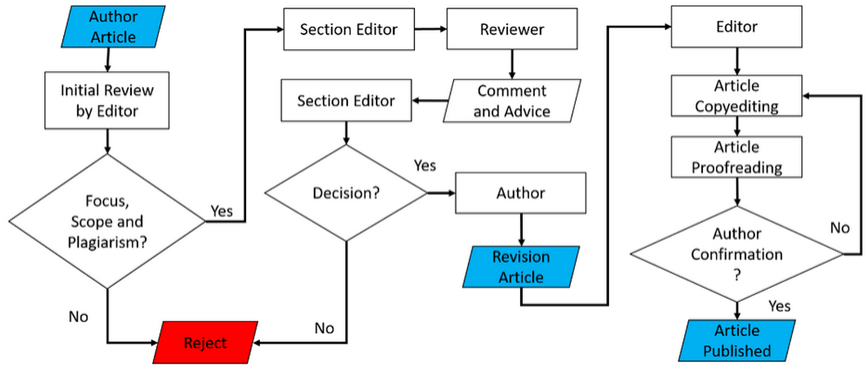
Figure 1. Peer Review Process