Peer Review Process
1. Policy Statement
The Journal of Computer Science Application and Engineering (JOSAPEN), published by Lentera Ilmu Publisher, is committed to maintaining high standards of academic quality, research integrity, impartiality, and publication ethics. The journal applies a structured triple-blind peer review process to evaluate the originality, relevance, methodological rigor, validity, and scholarly contribution of submitted manuscripts.
Under the triple-blind review model adopted by JOSAPEN, the identities of the authors, reviewers, and handling editor are concealed from one another during the peer review process. Appropriate editorial procedures are used to protect the confidentiality of identities and reduce the potential influence of personal relationships, institutional affiliations, reputational considerations, or other sources of bias.
All manuscripts undergo an initial editorial screening before being considered for external peer review. Manuscripts that satisfy the journal's preliminary requirements may be evaluated by at least two independent reviewers. The final publication decision rests with the authorized editor, taking into account the reviewers' reports, the authors' responses, and the journal's editorial and ethical standards.
2. Initial Editorial Screening
Upon submission, the editorial office checks whether the manuscript meets the journal's basic submission requirements and falls within JOSAPEN's aims and scope. The initial screening may include:
-
Relevance to the journal's focus and scope.
-
Originality and potential scholarly contribution.
-
Compliance with manuscript formatting and submission requirements.
-
Similarity screening using Turnitin or an equivalent tool, where available.
-
Preliminary assessment of research design, methodology, and presentation.
-
Compliance with applicable publication ethics requirements, including authorship, research ethics, competing interests, and duplicate submission.
Similarity scores are interpreted in context and are not used as the sole basis for determining whether plagiarism has occurred. The editor may reject a manuscript without external review, return it for preliminary corrections, or forward it for peer review.
3. Triple-Blind Peer Review Model
JOSAPEN uses a triple-blind peer review model designed to strengthen impartiality and minimize potential bias during manuscript evaluation.
Under this model:
-
Author identities are concealed from reviewers and the handling editor. Manuscripts are prepared and processed without identifying information that would unnecessarily reveal the authors' identities or affiliations.
-
Reviewer identities are concealed from authors and the handling editor. Reviewer names and identifying details are kept confidential and are not disclosed to authors during the review process.
-
The handling editor's identity is concealed from authors and reviewers. Editorial communications and decisions are issued through the journal's editorial office or submission system without ordinarily disclosing the handling editor's identity to the other parties.
The editorial office manages the review process and maintains the information necessary to coordinate submissions, reviewer assignments, and editorial decisions. Access to identifying information is restricted to authorized personnel who require it to administer the process.
Triple-blind review is intended to reduce the influence of identity-related bias; however, complete anonymity cannot always be guaranteed. Authors' identities may sometimes be inferred from writing style, self-citations, research topics, publicly available preprints, datasets, or other contextual information. JOSAPEN therefore asks all participants to respect confidentiality and avoid attempting to identify other parties unnecessarily.
4. Preparation of Anonymized Manuscripts
To support triple-blind review, authors must submit manuscripts that do not directly identify them or their institutions in the main review document.
Authors should:
-
Remove author names, affiliations, email addresses, and other direct identifying information from the anonymized manuscript.
-
Avoid acknowledgments that reveal author identities or institutional relationships during the review stage.
-
Review document properties and file metadata to remove author names and other identifying details where practicable.
-
Present self-citations in a neutral and academically appropriate manner without unnecessarily revealing author identity.
-
Submit title pages, declarations, funding information, acknowledgments, and other identifying details separately when required by the journal's submission system.
Authors must not remove relevant scholarly references or distort the presentation of previous research solely to conceal their identities. Anonymization should preserve the completeness, accuracy, and academic integrity of the manuscript.
The editorial office may return a submission for anonymization corrections before sending it for review.
5. Reviewer Selection and Responsibilities
Manuscripts that pass initial screening are assigned to at least two independent reviewers, subject to reviewer availability and the editorial requirements of the submission.
Reviewers are selected according to their subject expertise, research experience, and ability to provide a fair and technically informed assessment. The editorial office seeks to avoid reviewer assignments involving significant conflicts of interest.
Reviewers must:
-
Evaluate the manuscript objectively and provide evidence-based recommendations.
-
Assess originality, methodological quality, validity, relevance, clarity, and ethical compliance.
-
Maintain the confidentiality of the manuscript and all related review materials.
-
Disclose any actual, potential, or perceived conflicts of interest to the editorial office.
-
Avoid using unpublished information for personal, academic, or professional advantage.
-
Provide constructive feedback and identify concerns clearly.
-
Refrain from attempting to identify the authors or disclose their own identities during the review process.
If a reviewer has a conflict of interest or cannot complete the review, the reviewer should notify the editorial office promptly so that an alternative reviewer can be considered.
6. Review Criteria
Reviewers assess manuscripts according to the nature of the submission and JOSAPEN's academic standards. Relevant criteria include:
-
Relevance to the journal's aims and scope.
-
Originality, novelty, and scholarly contribution.
-
Adequacy of the literature review and engagement with prior research.
-
Appropriateness of the research design, methods, implementation, and analysis.
-
Validity and reliability of the findings.
-
Consistency between the evidence, interpretation, and conclusions.
-
Clarity, structure, technical accuracy, and quality of presentation.
-
Transparency and reproducibility, where applicable.
-
Appropriate citation practices and research ethics.
-
Significance and potential value to the relevant research community.
Reviewers should explain their recommendations and distinguish essential changes from suggestions intended to improve the manuscript.
7. Review Reports and Revisions
After the required review reports have been received, the editorial office communicates the decision and relevant reviewer feedback to the corresponding author without disclosing reviewer identities or the handling editor's identity.
When revisions are requested, authors must submit a revised manuscript and a point-by-point response within the specified deadline or request an extension from the editorial office.
The response should explain how each comment has been addressed and identify the corresponding changes in the revised manuscript. If the authors disagree with a recommendation, they should provide a clear, professional, and evidence-based explanation.
Revised manuscripts may be returned to the original reviewers or assigned to other qualified reviewers, depending on the nature of the revisions and the editor's assessment. Minor revisions may be evaluated by the editorial office when additional external review is not considered necessary.
Submission of a revised manuscript does not guarantee acceptance.
8. Editorial Decisions
Based on the initial assessment, peer review reports, revised manuscript, and author responses, JOSAPEN may issue one of the following decisions:
Reject: The manuscript is unsuitable for publication because of concerns involving scope, originality, methodological rigor, scholarly contribution, ethical compliance, or other substantial deficiencies.
Major Revision: Substantial changes are required before the manuscript can be reconsidered. The revised manuscript may undergo another round of external peer review.
Minor Revision: Limited changes are required before a final decision can be made. The editorial office may assess the revisions directly or seek further review if necessary.
Accept: The manuscript has satisfied the journal's editorial and peer review requirements and is accepted for publication, subject to routine production procedures.
Reviewers provide expert assessments and recommendations, but the final publication decision is made by the authorized editor in accordance with the journal's editorial policies.
9. Confidentiality and Editorial Independence
JOSAPEN maintains confidentiality throughout the review process. Manuscripts, reviewer reports, author responses, and identifying information must not be disclosed to unauthorized individuals.
The editorial office is responsible for administering the process and protecting identifying information. Access to identities is limited to authorized personnel where necessary for manuscript handling, quality control, ethical oversight, and administrative purposes.
Editors, reviewers, and authors must disclose relevant conflicts of interest. Where a conflict may compromise impartiality, the journal will take appropriate steps, which may include reassignment or independent assessment.
The journal does not guarantee that anonymity can never be breached, but it will make reasonable efforts to protect the identities of all parties and maintain the integrity of editorial decision-making.
10. Ethical Concerns and Appeals
If concerns arise regarding plagiarism, data fabrication or falsification, duplicate submission, inappropriate authorship, undisclosed conflicts of interest, or other potential research misconduct, the editorial office may suspend the review process while the matter is assessed under JOSAPEN's relevant publication ethics policies.
Authors may appeal an editorial decision by submitting a reasoned explanation and supporting evidence to the editorial office. Appeals will be assessed according to the journal's procedures and, where practicable, by an authorized person who was not directly responsible for the original decision.
The journal may seek additional independent expertise when necessary. The outcome of an appeal will be communicated to the corresponding author.
11. Acceptance, Production, and Publication
After acceptance, the manuscript proceeds to production, which may include copyediting, reference checks, typesetting, layout preparation, metadata verification, and proofreading.
Authors may be asked to review proofs and correct production errors within the specified timeframe. Substantive changes after acceptance require editorial approval.
The final article is published according to JOSAPEN's publication schedule and production procedures. Acceptance does not necessarily guarantee publication in a particular issue.
12. Review Timelines and Policy Review
JOSAPEN aims to process submissions promptly while maintaining the quality, fairness, and integrity of the review process. Review duration may vary according to manuscript complexity, reviewer availability, revision requirements, and the need for additional assessment.
Any stated average review duration should be based on the journal's actual editorial records. JOSAPEN may periodically update this policy to reflect developments in scholarly publishing and recognized publication ethics guidance, including relevant recommendations from the Committee on Publication Ethics (COPE).
13. Commitment to Fair and Confidential Review
JOSAPEN is committed to applying triple-blind peer review consistently and responsibly. By protecting the identities of authors, reviewers, and handling editors to the extent practicable, the journal seeks to support impartial evaluation, constructive scholarly exchange, and confidence in the published research record.
All participants are expected to cooperate with the editorial office and comply with the journal's peer review, confidentiality, conflict-of-interest, and publication ethics policies.
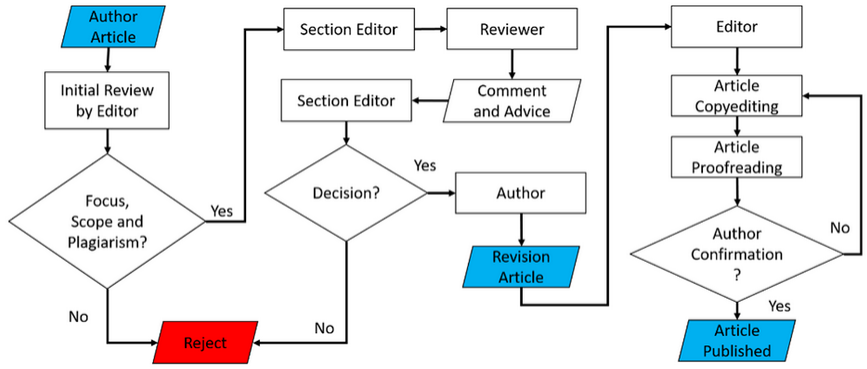
Figure 1. Peer Review Process